Beyond Obedience: How Chinese Family Values Are Evolving in the Modern World
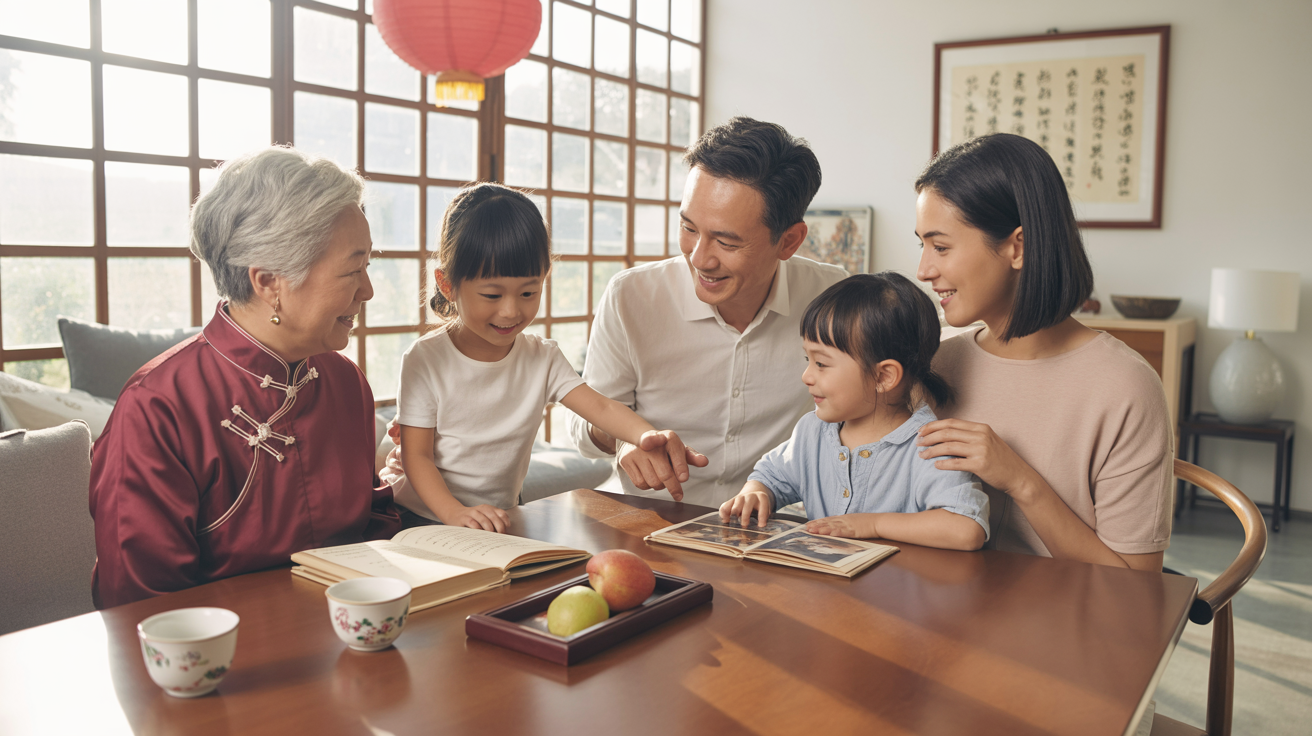
When you see a Chinese family gathered around a dinner table, you're witnessing more than a meal—you're seeing thousands of years of cultural values in action. But beneath the surface of respect and harmony, a quiet revolution is underway. Today's Chinese families are navigating an unprecedented tension between ancient Confucian ideals and the realities of modern life, creating new forms of family bonds that honor the past while adapting to the present.
The Foundation: Filial Piety as the Root of Virtue
At the heart of Chinese family culture lies filial piety, or xiào (孝)—a concept so fundamental that Confucius called it "the root of virtue." The Chinese character itself tells a story: the symbol for "old" (老) positioned above "son" (子), visually representing the younger generation supporting their elders.
But filial piety is far more than just respect. It's a comprehensive moral framework that includes:
- Caring for aging parents physically, emotionally, and financially
- Upholding family honor through personal conduct and achievements
- Consulting elders on major life decisions
- Honoring ancestors through rituals and remembrance
This creates a family hierarchy where authority flows from the eldest generation downward, and individual choices are rarely made in isolation. Your career, your marriage partner, even where you live—these decisions traditionally involve the entire family, not just you.
Values in Daily Life: Education, Harmony, and Sacrifice
Walk into any Chinese household, and you'll likely find education treated as a "family business." Parents invest enormous resources—time, money, emotional energy—into their children's academic success. A child's achievement isn't just personal; it's a victory for the entire family, bringing honor to parents and ancestors alike.
This collective mindset shapes how love is expressed. Rather than frequent verbal affirmations or physical affection common in Western cultures, Chinese parents often show love through action: working long hours to pay for tutoring, sacrificing personal comfort to ensure their child's success, providing financial support well into adulthood.
The pursuit of harmony (hé, 和) guides family interactions. Open disagreement with parents is often avoided, not out of fear, but as a sign of respect. As one Chinese-American described it, this can create cultural friction: "My American friends thought I was being dishonest when I didn't openly disagree with my parents. But for me, it was about maintaining family harmony and showing respect."
The Modern Crucible: "The Last Generation" and Neo-Familism
Today's young Chinese face a perfect storm of pressures that's forcing a dramatic re-evaluation of traditional family values. In affluent cities like Shanghai, raising a child from birth to age 15 can cost over $120,000. Add in skyrocketing housing prices, intense job competition, and the expectation to care for aging parents, and you have a generation feeling crushed by obligations.
This has given rise to a poignant phrase: "the last generation" (最后一代). Young people are delaying marriage, choosing to have fewer children or none at all, and some are opting for "DINK" (Double Income No Kids) lifestyles. It's not a rejection of family values—it's a quiet protest against a system where traditional expectations feel impossible to meet.
Sociologist Yan Yunxiang identifies a new phenomenon he calls "neo-familism." Unlike traditional family values focused on duty and respect, neo-familism centers on material success and consumption. Family resources now flow downward—from grandparents to children and grandchildren—creating what he calls "descending familism." Parents remain intensely involved in their adult children's lives, but the focus has shifted from moral cultivation to economic achievement.
Social media amplifies this pressure. Families compete not just for educational success but for visible markers of prosperity, intensifying anxiety across generations.
Regional Variations: Urban vs. Rural, Mainland vs. Diaspora
Chinese family values aren't monolithic—they vary significantly by location and context.
Within China, urban-rural divides are stark. Traditional extended family households remain common in rural areas, where multiple generations live under one roof. In cities, nuclear families are increasingly the norm, and gender roles are evolving faster. The One-Child Policy (1979-2015) fundamentally altered family structures, creating millions of "2+1" families (two parents, one child) and placing unprecedented pressure on single children to fulfill all family expectations alone.
In diaspora communities, Chinese families face a different challenge: balancing traditional values with Western individualism. Core principles like filial piety and collective identity persist as cultural anchors, but younger generations must navigate between their family's expectations and their adopted country's values.
A second-generation Chinese-Canadian might struggle with parental pressure to choose a "practical" career like medicine or engineering when they're passionate about art. A Chinese-Australian might face family disapproval for moving far from home to pursue opportunities. These aren't rejections of family values—they're negotiations, attempts to honor tradition while claiming personal autonomy.
The Enduring Core
Despite these transformations, certain values remain remarkably resilient. The vast majority of Chinese families still consider placing elderly parents in care facilities shameful. Education remains a top priority. The concept of "face"—maintaining family honor through personal conduct—continues to influence decisions large and small.
What's changing is how these values are expressed. Modern filial piety might mean regular video calls rather than living in the same household. It might mean emotional support and quality time rather than just financial provision. Young people are finding ways to honor their parents while also honoring themselves.
A Living Tradition
Chinese family values aren't frozen in time—they're a living tradition, constantly adapting to new realities while maintaining their essential core. From the Confucian scholars of ancient China to the "last generation" of today's youth, from rural villages to diaspora communities worldwide, these values continue to shape how millions of people understand their place in the world.
The tension between tradition and modernity isn't a crisis—it's a conversation, one that's been happening for generations and will continue for generations to come. And in that ongoing dialogue between past and present, Chinese families are creating new forms of connection that honor where they've been while embracing where they're going.
Understanding Chinese family values offers a window into one of the world's oldest continuous cultures. Whether you're learning about China for the first time or reconnecting with your heritage, recognizing how these values evolve helps us appreciate both their enduring wisdom and their remarkable adaptability.