Beyond the Great Wall: Exploring China's Vast Regional Tapestry
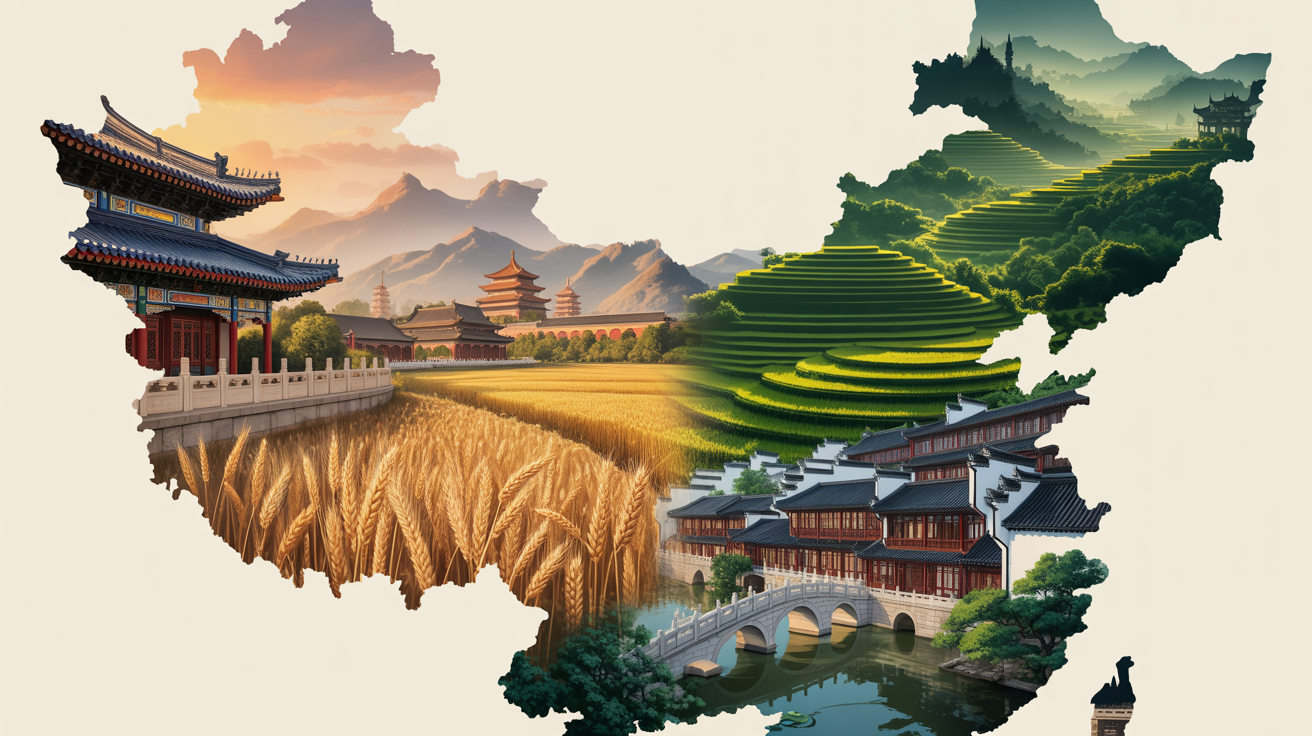
When we think of China, we often conjure a single, monolithic image. Yet, to view this vast nation as a uniform entity is to miss the rich, complex, and deeply fascinating mosaic of cultures, landscapes, and identities that thrive within its borders. From the wheat fields of the north to the southern rice paddies, and from the bustling coastal megacities to the rugged inland provinces, China is a country of profound regional differences. These distinctions, carved by geography, history, and climate, manifest in everything from the food people eat and the words they speak to their core cultural values.
The Great Divide: North vs. South
The most fundamental division in China is the one between the North and the South, a line drawn not by politics but by nature itself: the Qinling-Huaihe Line. This geographical boundary separates the country into two distinct climatic and agricultural zones, which in turn have shaped two different ways of life.
Northern China, the cradle of Chinese civilization along the Yellow River, experiences long, cold, dry winters and hot summers. This climate is ideal for growing wheat, corn, and sorghum. Consequently, the Northern diet is built on wheat-based staples like noodles, dumplings, and steamed buns. Historically the political heartland, home to ancient capitals like Beijing and Xi'an, the North has a legacy of defending against nomadic invaders. This history has fostered a culture often stereotyped as direct, outspoken, and gregarious. Northerners are generally perceived as being taller and more robust, with a penchant for discussing politics.
Southern China, by contrast, is a land of subtropical warmth, abundant rainfall, and lush greenery. Defined by the mighty Yangtze River, its mild winters and humid summers are perfect for cultivating rice. The Southern diet is rice-based, complemented by an abundance of seafood and tropical fruits like mangoes and lychees. Historically a frontier region that grew through migration from the north and maritime trade, the South developed a culture often seen as more reserved, entrepreneurial, and interdependent. Southerners are stereotypically described as being more detailed in their planning and skilled in business.
The Economic Engine: Coastal vs. Inland
Another critical divide is between the prosperous coast and the developing interior. Since the economic reforms of the late 1970s, China's government has strategically prioritized its coastal regions, transforming them into global hubs for manufacturing, finance, and technology. Cities like Shanghai, Shenzhen, and Guangzhou have exploded, with the coast's share of national GDP growing to around 60%. This economic boom, fueled by access to sea transport and foreign investment, has come at a cost, leading to significant environmental challenges, including pollution and the loss of natural habitats.
In contrast, inland provinces have developed at a slower pace. Though historically prosperous, these regions were often hampered by their geography and distance from global trade routes. In recent decades, government initiatives like the "Western Development Strategy" have aimed to bridge this economic gap, but a significant disparity remains. Culturally, the coast boasts a rich maritime heritage, including unique festivals and beliefs like the Mazu goddess worship, while inland areas preserve other ancient traditions.
A Babel of Tongues: The Landscape of Language
While Standard Chinese (Mandarin) is the country's official language, it is just one of hundreds of local linguistic varieties. The differences between these "dialects" are often so great that they are mutually unintelligible, more akin to the relationship between Spanish and Italian than between British and American English.
The North is linguistically quite homogeneous, dominated by varieties of Mandarin. The South, however, is a patchwork of distinct language groups.
- Cantonese (Yue) is the language of Guangdong province, Hong Kong, and Macau, and is widely spoken in overseas Chinese communities. With its six tones and preservation of ancient final consonants, it is completely unintelligible to a Mandarin speaker.
- Wu, spoken in Shanghai and the surrounding region, is another major variety.
- Min, spoken in Fujian province and Taiwan, is so diverse that people from neighboring villages may not understand each other.
- Hakka is spoken by communities scattered across southern China, a testament to their history as migrants.
This linguistic diversity is a source of immense regional pride and a key component of local identity.
A Taste of Diversity: The Eight Great Cuisines
Nowhere are China's regional differences more deliciously apparent than in its food. The country is home to the "Eight Great Cuisines," each with its own distinct ingredients, techniques, and flavor profiles.
- Sichuan (Chuan) Cuisine is famous for its bold, pungent, and spicy flavors, particularly the unique numbing sensation of the Sichuan peppercorn. Signature dishes include Kung Pao Chicken and Ma Po Tofu.
- Cantonese (Yue) Cuisine from the south is the polar opposite, emphasizing light, fresh, and natural flavors with minimal seasoning. It is the home of dim sum, steamed fish, and roast pork.
- Shandong (Lu) Cuisine, a northern style, is known for its fresh, salty flavors, often featuring seafood, and techniques like quick stir-frying.
- Other traditions include the hot and sour flavors of Hunan (Xiang) cuisine, the delicate soups of Fujian (Min), and the artistic, slightly sweet dishes of Jiangsu (Su).
Modern Identity and Enduring Stereotypes
These deep-seated regional differences give rise to a colorful tapestry of local stereotypes. Beijingers are often seen as talkative and obsessed with politics. People from Wenzhou have a reputation for being brilliant in business, earning them the nickname "the Jews of the Orient." Women from Sichuan are famously called "là mèi zi" (spicy girls), a nod to both their region's fiery cuisine and their reputed beauty and strong personalities.
While often humorous, these perceptions reflect real economic and cultural distinctions. The hukou household registration system has historically reinforced divides between urban and rural populations, sometimes leading to discrimination against migrant workers.
Today, as high-speed rail and the internet connect the country more than ever, these regional identities remain vibrant. For tourists, this diversity offers a spectacular range of experiences, from the imperial grandeur of Beijing's Forbidden City and Xi'an's Terracotta Warriors in the north to the stunning natural beauty of Guilin's karst mountains and Zhangjiajie's national park in the south.
China is not one place, but many. It is a dynamic and ever-evolving nation where ancient history and modern ambition intersect, and where a journey of a few hundred miles can feel like entering an entirely new world.