Nine Times Nine: The Double Ninth Festival and China's Beautiful Tradition of Honoring Elders
There's a festival in China that most outsiders have never heard of, yet it quietly captures something essential about Chinese culture: the belief that honoring those who came before us is not a burden, but a gift. The Double Ninth Festival — known in Chinese as Chóngyáng Jié (重阳节) — falls on the ninth day of the ninth lunar month each year, and it is one of the most layered, meaningful, and underappreciated holidays in the Chinese calendar.
A Name Written in Numbers
The festival's name is rooted in ancient Chinese cosmology. According to the I Ching (Book of Changes), the number nine is a yang number — associated with brightness, masculinity, and positive energy. When two nines converge on the calendar, the result is chóngyáng (重阳), or "double yang." In ancient times, this excess of yang energy was considered potentially dangerous, a day when the balance of the universe tipped and misfortune could follow. Rituals were needed to restore harmony.
Over two millennia, those protective rituals evolved into a rich tapestry of customs. Today, the Double Ninth Festival is a day for climbing mountains, admiring chrysanthemums, eating special cakes, and — in its most meaningful modern form — celebrating the elderly people in our lives.
The Legend That Started It All
Every great Chinese festival has a story, and Chongyang's is particularly vivid. During the Han Dynasty (202 BC – 220 AD), a man named Huan Jing studied under an immortal master named Fei Changfang. One day, Fei warned his student that a terrible plague would descend upon his village on the ninth day of the ninth month. To protect his family, Huan was instructed to take them to the mountains, carrying sprigs of zhuyu (dogwood) and a flask of chrysanthemum wine.
Huan followed the advice. When he returned home that evening, he found that all his livestock had perished — but his family was safe. The mountain, the dogwood, and the chrysanthemum wine had shielded them from disaster.
This legend gave birth to three of the festival's most enduring traditions: ascending to high places, wearing or carrying dogwood, and drinking chrysanthemum wine. Even today, these customs echo across China and its diaspora communities worldwide.
Climbing High: The Festival's Most Iconic Tradition
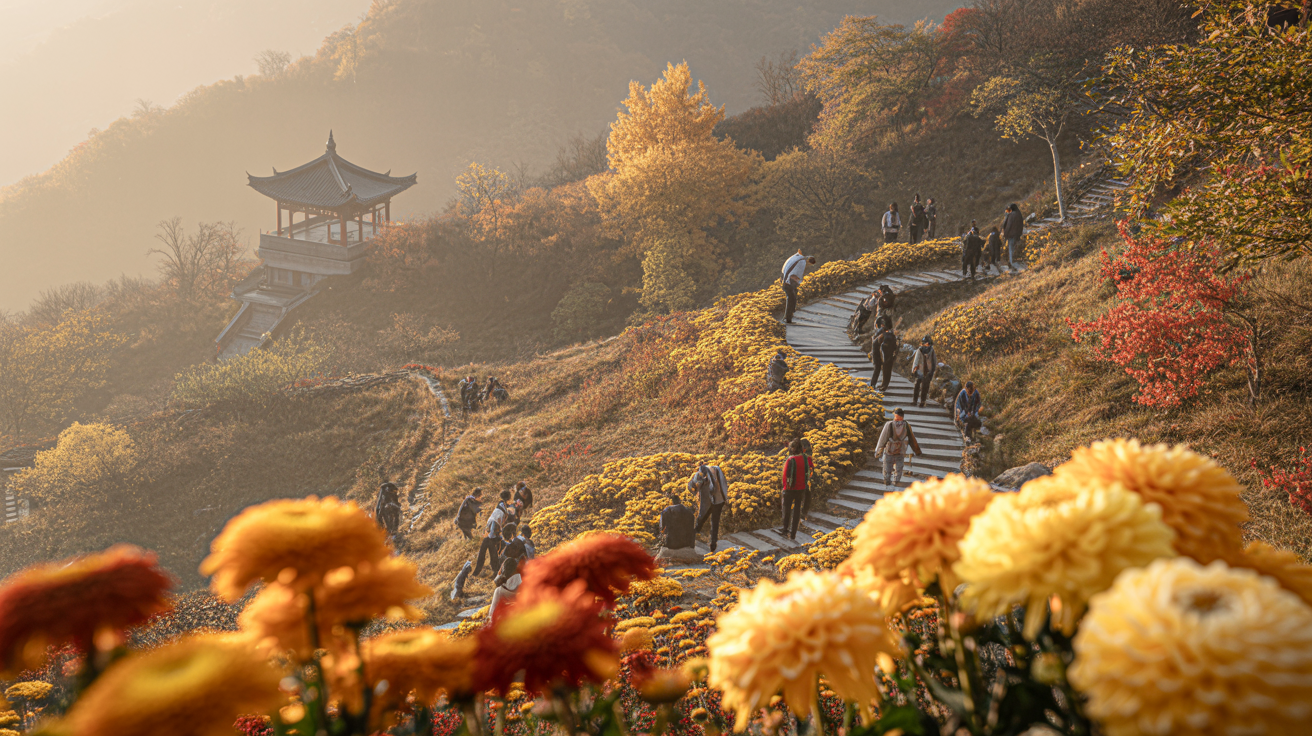
Ask any Chinese person about Chongyang, and the first thing they'll mention is dēng gāo (登高) — climbing to high places. Families and friends head to hills, mountains, or even tall buildings to mark the occasion. The act carries both practical and symbolic weight: physically, it was believed to help one escape the plague-like misfortunes associated with the double-yang day; metaphorically, "ascending to greater heights" represents ambition, progress, and the hope for a better future.
In modern China, dēng gāo has become a beloved autumn outing. The ninth lunar month typically falls in October or November, when the air is crisp, the leaves are turning, and the landscape is at its most spectacular. Parks and scenic areas fill with hikers of all ages, making it one of the most visually beautiful festivals of the year.
Chrysanthemums, Cakes, and Clever Wordplay
The chrysanthemum is the undisputed flower of Chongyang. Blooming defiantly in the cooling autumn air, it symbolizes resilience, vitality, and longevity — qualities the Chinese deeply admire. During the festival, elaborate chrysanthemum exhibitions fill public parks, and chrysanthemum wine or tea is consumed for its believed health benefits.
Then there's the Chóngyáng gāo (重阳糕) — the festival cake. These steamed pastries, often made with glutinous rice flour and decorated with nuts, dried fruits, and red dates, are sometimes crafted in nine layers to resemble a miniature pagoda. The reason for eating them is a delightful piece of Chinese linguistic creativity: the word for cake, gāo (糕), is a homophone for "high" (高). Eating the cake is therefore a symbolic act of "rising higher" — in health, in career, in life. It's the kind of playful meaning-making that makes Chinese culture so endlessly fascinating.
A Festival Reborn: Honoring China's Elders
The most significant transformation of the Double Ninth Festival came in 1989, when the Chinese government officially designated it as Lǎorén Jié (老人节) — Senior Citizens' Day. The reasoning was elegant: the Chinese pronunciation of "nine nine" (jiǔ jiǔ) is identical to the word for "long-lasting" or "longevity" (久久). What better day to honor the elderly than one whose very name evokes a long life?
Taiwan had made a similar designation back in 1966, recognizing the festival as a day to celebrate senior citizens and promote filial piety — the Confucian value of deep respect for one's parents and ancestors.
Today, Chongyang is as much about grandparents as it is about mountains. Families make special efforts to visit elderly relatives, take them on outings, prepare their favorite meals, or simply spend quality time together. Companies organize trips for retired employees. Community centers host events for senior members. It's a day that asks younger generations to pause, look back, and say: we see you, we value you, we are grateful.
Across Borders: How the World Celebrates Chongyang
In Hong Kong and Macau, Chongyang (known locally as Chung Yeung) is a statutory public holiday with a distinctly solemn dimension: families visit ancestral graves to clean the tombs, repaint inscriptions, and make offerings of food and incense. It's a powerful act of remembrance that connects the living to the dead across generations.
In Taiwan, the day is observed as Senior Citizens' Day, with local governments sometimes distributing small gifts or cash payments to the elderly as a gesture of communal respect.
For the global Chinese diaspora, Chongyang is celebrated in adapted but meaningful ways. Community organizations in cities from San Francisco to Sydney host group hikes, family dinners, and cultural workshops. Even a simple walk in a park — a nod to the ancient tradition of dēng gāo — can be a way of staying connected to heritage.
The festival's influence also extends beyond China's borders. Japan's Kiku no Sekku (Chrysanthemum Festival) shares deep roots with Chongyang, and Korea's Jungyangjeol is celebrated with outdoor activities and chrysanthemum-infused pancakes.
Why Chongyang Matters Today
In an era when many societies struggle with how to treat their aging populations, the Double Ninth Festival offers a quietly radical proposition: that growing old is not something to be hidden or feared, but celebrated. That the wisdom accumulated over a lifetime is a treasure, not a burden. That the act of climbing a mountain together — young and old, side by side — is itself a kind of prayer.
For foreigners discovering Chinese culture, Chongyang is a beautiful entry point. It shows a civilization that has, for thousands of years, built reverence for elders into the very fabric of its calendar. And for members of the Chinese diaspora, it's a reminder that no matter how far you travel, some traditions carry their meaning across every border.
This autumn, when the ninth day of the ninth lunar month arrives, consider raising a cup of chrysanthemum tea, finding the nearest hill, and calling someone older than you to say: I'm glad you're here.