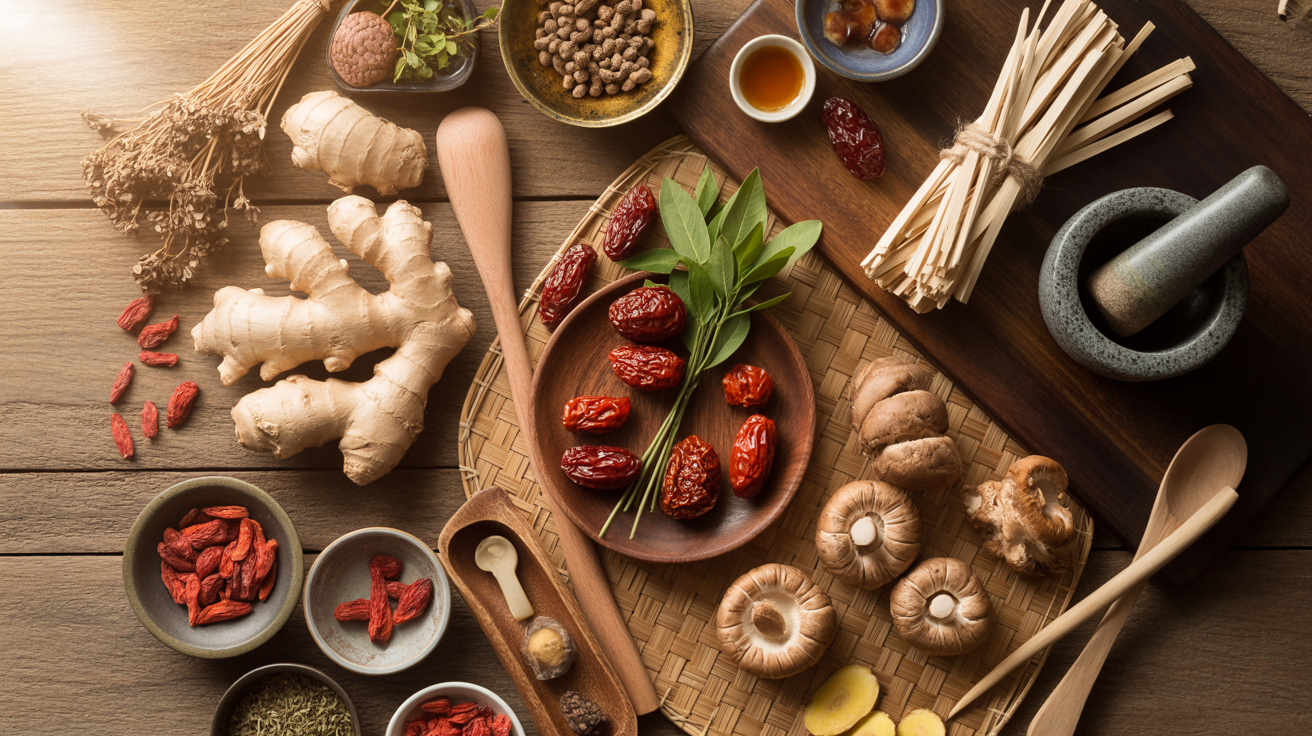
Your Kitchen Is a Pharmacy: The Ancient Chinese Art of Food as Medicine
Your Kitchen Is a Pharmacy: The Ancient Chinese Art of Food as Medicine
When a Chinese grandmother offers you a bowl of ginger tea for a cold, or insists you eat more warming foods in winter, she's not just being caring—she's practicing a sophisticated form of medicine that's thousands of years old. In Chinese culture, the boundary between food and medicine has always been intentionally blurred, guided by the principle that "medicine and food share a common origin" (yàoshí tóngyuán).
This isn't about superfoods or trendy wellness fads. It's a comprehensive system of dietary therapy that views every ingredient as having specific energetic properties that can prevent illness, restore balance, and maintain health. Your kitchen, in essence, is your first pharmacy.
A Philosophy Older Than Empires
The roots of Chinese food therapy stretch back millennia. Legend credits the mythical emperor Shennong with tasting hundreds of herbs to determine their medicinal and edible properties—a dangerous job, but someone had to do it. The theoretical foundation, however, was systematically laid out in the Yellow Emperor's Inner Canon (Huangdi Neijing), compiled between 221 BCE and 220 CE, which remains a cornerstone of Traditional Chinese Medicine (TCM) today.
What's remarkable is how seriously this was taken historically. During the Zhou Dynasty (c. 1046–256 BCE), the emperor's court employed nutritionists called Shi Yi who ranked higher than physicians. Their job? Creating balanced meals according to the seasons to keep the ruler healthy. Prevention through diet was considered more important than treatment through medicine.
This philosophy was further refined in the 7th century when physician Sun Simiao wrote in his text Prescriptions Worth a Thousand Gold that food should always be the first line of treatment before resorting to medicinal drugs. It's a principle that resonates strongly today as modern healthcare shifts toward preventive care.
The Dance of Yin and Yang on Your Plate
At the heart of Chinese dietary therapy is the concept of Yin and Yang—the complementary forces that govern all things in the universe. When applied to food, this philosophy classifies ingredients based on their energetic properties and how they affect your body's internal energy, or qi.
Yin foods are cooling, moistening, and calming. Think cucumber, watermelon, tofu, spinach, and green tea. These are your go-to ingredients when you're feeling overheated, inflamed, or irritable. They're especially favored during hot summer months or for people with naturally "hot" constitutions who tend to feel warm, thirsty, or restless.
Yang foods are warming, drying, and energizing. Ginger, lamb, chicken, chili peppers, and cinnamon fall into this category. These foods are used to dispel internal "cold," boost circulation, and provide energy. They're ideal for cold weather or for people who are always cold, fatigued, or have poor circulation.
Neutral foods like rice, carrots, and shiitake mushrooms are perfectly balanced and form the foundation of a healthy diet.
The goal isn't a rigid 50/50 split but rather a mindful adjustment based on your individual constitution, the season, and your current health. Someone prone to night sweats and irritability would benefit from more cooling Yin foods, while someone who's always cold and tired needs more warming Yang ingredients.
The Five Tastes: More Than Just Flavor
Beyond Yin and Yang, Chinese cuisine is structured around the Five Tastes (wǔ wèi): sour, sweet, bitter, pungent (spicy), and salty. In TCM, each taste corresponds to and influences a specific organ system:
- Sour (vinegar, lemon) → Liver: aids digestion and constricts tissues
- Sweet (honey, cherries) → Spleen: tones the body and improves mood
- Bitter (bitter melon, arugula) → Heart: clears heat and dries dampness
- Pungent/Spicy (ginger, chili) → Lungs: promotes circulation and expels pathogens
- Salty (soy sauce, seaweed) → Kidneys: dissolves stagnation
A well-balanced meal incorporates all five tastes in harmony. This isn't just about health—it's also why Chinese cuisine is so complex and satisfying. The interplay of flavors creates both culinary delight and physical well-being.
Regional Wisdom: Climate Shapes the Plate
These principles aren't applied uniformly across China—they're adapted to regional climates and conditions. In the humid climates of Sichuan and Hunan, pungent and spicy foods are used liberally to combat internal "dampness" and promote sweating. In the cold north, salty flavors from pickled vegetables historically provided sustenance and warmth through long winters. The sweeter cuisine of eastern China, such as in Jiangsu, is believed to help "tone the body" and provide gentle nourishment.
This regional variation shows the sophistication of the system—it's not a one-size-fits-all approach but a flexible framework that adapts to environment and individual needs.
Ancient Wisdom Meets Modern Life
Today, both in China and among the global diaspora, this ancient wisdom continues to resonate. While urbanization and fast food present challenges to traditional dietary patterns, there's also a growing movement to modernize and internationalize the concept of food as medicine.
For many in the Chinese diaspora, cooking with these principles is a powerful way to connect with cultural heritage while nurturing health. It's a tangible link to ancestors and traditions, practiced not in temples or museums but in the everyday act of preparing a meal.
Modern science is also beginning to validate these ancient practices. Research into "food-medicine homologous resources" is lending contemporary credibility to what grandmothers have known for generations. The focus is evolving from unconscious tradition to conscious "food therapy" that's precise, personalized, and integrated into modern wellness lifestyles.
Your Kitchen, Your Healing Space
The beauty of Chinese food therapy is its accessibility. You don't need exotic ingredients or complicated recipes. A simple bowl of congee (rice porridge) is considered deeply nourishing and easy to digest—perfect for recovery from illness. Ginger tea for a cold, chrysanthemum tea to cool down in summer, red date soup for energy—these are simple, everyday practices that anyone can adopt.
The lesson is profound: your kitchen can be a place of healing, and every meal is an opportunity to create harmony, pleasure, and health. It's a tradition that views food not as a collection of calories and macronutrients, but as a dynamic force for balancing the body and nourishing life itself.
So the next time someone offers you a specific food for a specific ailment, know that you're receiving not just a meal, but thousands of years of accumulated wisdom about how to live well. Your grandmother's insistence that you eat more warming foods in winter? That's not superstition—that's medicine.